Mini Cart

Great Article by www.rtnnewspaper.com

RESEARCH RELEASED last week has revealed two thirds of dogs* suffer from some sort of health issue such as allergies, dental or stomach problems.

Bad breath is the most common problem (26 per cent) and over 20 per cent admit their dog is overweight. Despite this, over 60 per cent of owners aren’t aware that poor nutrition is one of the leading causes of health issues such as these, which can be vastly improved by changing to a raw diet.

Of the owners surveyed, the research has also revealed a lack of understanding of what really goes into our dogs’ food. Almost a quarter (23 per cent) of dog owners admit to paying little or no attention to what’s on the label of the current dog food they purchase and over 10 per cent say they don’t really know what’s healthy or nutritious for their furry friend.

Interestingly, men (32 per cent) are less likely to check the label on their dog food versus women (36 per cent) and similarly women (29 per cent) are more aware of what’s healthy for their dog compared to their male counterparts (27 per cent).

Raw feeding aims to give dogs a diet appropriate to their digestive system and as close as possible to what they might have eaten as wild animals. It has been shown on countless occasions to make an extraordinary difference to a pet’s health and wellbeing.

Craig Taylor, Managing Director of Natures Menu, Europe’s leading expert in raw pet food, said: ‘We all care so much about our furry friends and this should extend to what we’re feeding them too. Standard dog food often may seem like it’s the best for your pet, but on closer inspection many contain ingredients such as sugars, meat meals and meat derivatives that just aren’t as healthy or nutritious.’

‘Raw feeding not only has its benefits in terms of nourishment and easy digestion, but has also been shown to help alleviate a number of health issues, such as chronic skin and digestive problems. If your dog is suffering from any sort of health issue, we always recommend speaking to your vet for advice but switching to raw could really make a world of difference.’

There are a number of factors that point towards a health problem in dogs. Here are the ones to look out for which could indicate an underlying issue, all of which are often easily alleviated by a change in diet:

1. Bad breath
2. Poor digestion
3. Dull fur, dry or itchy skin
4. Change in activity levels or behaviour
5. Lack of appetite

Great Article by www.dogfoodadvisor.com

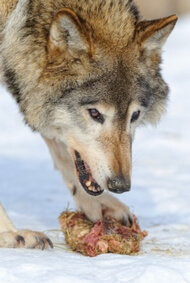
A raw dog food diet is designed to mimic a dog’s natural ancestral menu. The whole concept of raw feeding is based upon a dog’s instinctive carnivorous bias — a built-in desire to capture (or find) and eat another animal.
Wolf with Raw Food

As unsavory as it may seem, it is completely natural for a wolf to consume the entire animal.

Meat, bones, organs and all.

As direct descendants of wolves, dogs are simply not genetically optimized to consume the 50% carbohydrate content of today’s commercial kibbles.

So, how do these diets compare?

The Ancestral Diet
Compared to Dry Kibble

No one can argue the dry baked pellets we call dog food aren’t convenient. Yet the nutrient profile of a dry kibble is nowhere near the nutrient content of a dog’s ancestral diet.

Canine Ancestral Diet versus Dry Dog Food

Notice the higher carbohydrate content of the kibble compared to the dog’s natural ancestral diet. Or how about the dramatically lower protein and fat levels?

The Benefits of a Raw Diet

Feeding a raw dog food diet has many notable benefits…

  • Firmer stools
  • Improved digestion
  • Healthier skin and coat
  • Reduced allergy symptoms
  • Better weight management

There have been many reports of improved health when chronically ill pets were switched from a commercial product to a raw dog food.

The Downside
of a Raw Dog Food Diet

A raw dog food diet can’t touch the convenience of a kibble. Just measure and pour. It just doesn’t get any easier.

Yet besides the lack of convenience, there’s another critical issue. Bacterial contamination.

Salmonella and E. coli germs can always be a potential problem with raw meats. Yet the risk of food-borne disease is actually quite low.

That is, low risk for dogs. But not for humans.

That’s because a dog’s digestive system is shorter and more acidic.

Which makes canine infections like these fairly rare.

The real risk of food-borne disease is actually greater for a dog’s human caretakers — not the dog.

Yet with proper care and handling, this risk can be dramatically reduced.

How to Use Our List

Below you’ll find a list of the Advisor’s suggested raw dog foods. Of course, this list should not be considered a complete catalog of all the raw dog foods on the market.

For there are others. Many others.

We only provide this small group as a starting point.

As a matter of fact, if you know of a specific dog food you believe we should have included on this list, please feel free to share your recommendations in the Comments section below.

Or if you’re looking for some suggestions yourself, be sure to look through our readers’ Comments to find more good ideas.

Suggested Raw Dog Foods

A fun and interesting article by Ed Lukacevic from www.homemadedogfood.com


Homemade Dog Food is Healthy and Nutritious

Homemade Dog Food is Healthy and Nutritious

Homemade dog food can be the most nutritious food you can feed your dog.

Thank you for stopping in and checking out my site. My goal is to help you feed your dog healthy, nutritious homemade dog food. The best dog food you make right in your kitchen. All the  homemade dog food ingredients are readily available at your local grocery store. The homemade dog food recipes are easy to follow and simple to make. Most importantly your dog will thrive on these homemade dog food recipes and love the way they taste.

I believe dogs are designed to digest raw meat and bones the best. So I present raw homemade dog food recipes throughout this website as the best dog food for your dog. That said, I know many of you just can’t bring yourself to feed your dog a homemade dog food that contains raw meat. So I also present cooked  homemade dog food recipes that are healthy and nutritious. I believe these homemade dog food recipes are still vastly superior to commercial kibble. Your dog will too!

If you are new to the site and possibly websites in general let me offer this information. The links on this site are “yellow gold” click them and they will take you to that “topic” or page. An example might be to click here to see a new page with a screen shot of the links and navigation menu. They do not have to say “click here” to be clickable. Also at the top of the website is the main menu where you can navigate to other sections of the website. There are also sub menu topics under the main menu topics. Just “mouse over” the menu topics  and the subtopics will appear.

Homemade  Dog Food Recipe

This is my first homemade dog food recipe video. I hope you like it. My goal is to have a video for each homemade dog food recipe. Happy viewing:)

 FAQ About Homemade Dog Food

Question: Some of your homemade dog food recipes contain raw ground beef and chicken Is it safe to feed these items to my dog? What about the bacteria in the homemade dog food recipe?

Answer: Yes, it is safe to feed these ingredients to your dog. Dogs are carnivores and scavengers by nature. Dogs have a short digestive tract with strong stomach acids that protect them from getting sick from bacteria on food. This is how a dog can eat garbage and not become deathly ill.

Question: I’ve also heard they feed cattle antibiotics and other things aren’t these bad for my dog?

Answer: Maybe. I think of it this way. The food in your grocery store is considered fit for human consumption. The ingredients in dog food are considered NOT fit for human consumption! What ingredient do you think are better to include in a homemade dog food recipe?

Question: I notice you don’t use vegetables in your homemade dog food can I add them?

Answer: Like I said earlier, dogs are carnivores and have a short digestive tract. A dog’s short digestive tract is ill equipped to digest vegetables and receive their nutrients. So most just pass through as roughage. If you are determined to feed vegetables they need to be “predigested” so to speak. Cook and pulverize them to simulate them going through the digestive tract of a herbivore. Then add them to the homemade dog food.

Question: Why do you include white rice in your homemade dog food? Isn’t brown rice better?

Answer: Remember dogs have a short digestive tract. A dog’s short digestive tract does not effectively digest brown rice. The vast majority of any nutritional benefit to your dog just passes through undigested. White rice is better because it is easily digest by dogs. Brown rice is great for humans because we are omnivores with a long digestive tract. A human’s long digestive tract digests the brown rice and unlocks the nutritional benefits.

  Easy Homemade Dog Food Recipes to Get You Started

A wonderful article by


why not just give them meat-DNM2


(NOTE: We talk about feeding raw meat a lot! There are so many benefits to feeding a raw diet that it’s impossible to list them all here. Click the image below to get our free Introduction To Raw Feeding Video Guide and get started feeding raw!)

Raw Feeding

At a Waltham Nutritional Sciences Symposium, researcher Professor Wouter Hendriks presented more evidence that dogs are carnivores (you can see the video summary here). Those of us who feed raw are inclined to say, “Yeah? So what?” We’ve all taken that for granted, given the dog’s sharp, pointy carnivore teeth and carnivorous ancestors. So when I saw some web pages discussing this “new” finding, I was curious to see what anyone would get excited about.

Well, it seems like this might be news to some vets. “In veterinary school we learned that cats are carnivores; horses, rabbits and ruminants are herbivores; and pigs and dogs ­­— like people — are omnivores” says veterinarian Dr Patty Khuly in a recent article.

The vets further solidified their position of dogs as omnivores when a study was published in the scientific journal Nature earlier this year. The summary of that report was:

“Our results indicate that novel adaptations allowing the early ancestors of modern dogs to thrive on a diet rich in starch, relative to the carnivorous diet of wolves, constituted a crucial step in the early domestication of dogs.”

Dogs Are Carnivores…

Last month, professor Hendriks added another dimension to this study. His work shows that just because dogs have adapted to omnivorous diets doesn’t make them omnivores. Although the researchers in the starch study found a few genes that reflected adaptation to starches, “just a few genes’ difference is regarded as an adaptive shift to a condition. These alone can’t possibly alter the entire digestive evolution of a species” says Dr Khuly.

Dr Khuly also adds that dogs have the following carnivorous traits:

  • Dogs’ teeth are adapted to a carnivorous diet (for tearing muscle and crunching bone to extract marrow).
  • Many of their innate behaviors are carnivorous in nature. Consider digging, for example. Like wolves, dogs dig to hide parts of meals for future ingestion.
  • Dogs, like many large mammalian carnivores, are metabolically able to survive for long periods of time between meals.
  • Dogs have a lot of flexibility in metabolic pathways to help make up for a feast-or-famine lifestyle and a wide range of possible prey.

I’d agree with her up until this point. Dr Khuly then concludes, “The result of these findings, argues Dr Hendriks, is that the dog is undeniably a true carnivore. The dog just happens to have an adaptive metabolism as a result of living with humans for millennia. That’s why the dog is perfectly capable of eating a grain-based diet, as most commercially fed dogs do.”

…But Not To Vets

Hold on there. How did we get from “dogs are undeniably carnivores” to “keep on feeding them a grain based diet” in the same paragraph? What just happened there?

Diabetes, a condition where the body is  unable to properly metabolize glucose from carbohydrates, is the most common endocrine disease affecting dogs today and its prevalence is growing every year. Thirty years ago, 0.19% of dogs suffered from diabetes. In 1999, the rate tripled to 0.58%. Today, up to 1.5% of dogs suffer from diabetes.

I’d be the first to admit that diabetes is an autoimmune disease and I’d happily attribute it to vaccine damage. But it also bears stating that unnatural foods lead to unnatural outcomes … like diabetes.

I know that when this article is published, the conventional vets and proponents will say what I’m writing is mostly speculation, there’s no science to back it up. And they’d be right.

But to those vets who continue to feed carbohydrate-laden foods, despite the growing body of research showing that dogs are carnivores, and despite the rise of metabolic disease related to carbohydrate intake, I have this question to ask:

Where is the research backing your carbohydrate-based diets? Feeding trials? Give me a break – just because a dog lives for three months eating your food without any overt signs of disease doesn’t mean that food will sustain him and keep him healthy for a lifetime.

I’m tired of being asked for references and research when vets and kibble companies continuously make huge leaps in logic, despite the overwhelming evidence that dogs are carnivores. Somewhere along the line, shouldn’t somebody stick up their hand and ask why we started feeding dogs corn and rice in the first place? What drove that initial decision?

My vote is MONEY.

Kibble Is Made For People With Wallets, Not Dogs

From the time James Spratt tossed hard tack off the side of his ship to the dogs on the docks, to the first kibbles that had dogs chasing chuck wagons around the house, kibble has had one goal and one goal alone: make money from pet owners.

Does your dog have a wallet? Mine don’t, so I buy all their things for them. And the kibble manufacturers figured that out a long time ago, and directed their marketing to the people with the wallets, not the furry beings who would be consuming their food. So we as humans watched the chuck wagon commercials and thought our dog would really like that stuff. We never paid much attention to what was in the bag, just that it looked cool and we loved potatoes and corn, so why wouldn’t our dogs? Now that we pet owners know better, I have to wonder how much thought vets have given to what’s in the bag.

Now there are two kinds of vets. Those who mindlessly chase chuck wagons and those who don’t. Do you know how to tell the difference between them? That’s simple. One will have shelves full of kibble in their waiting area and one won’t.

I for one wish vets would wake up and see kibble for what it is. It’s a relic from days long gone, when we didn’t know any better. Nobody took the time to figure out what dogs should eat and when people started pumping money into dog food, the pet food companies were more concerned with making their brand better than their competitor than asking, why are we putting starches into these foods? Well, they probably did ask that question and the answer was likely, “because it’s cheaper.”

So now, pet owners are starting to see their furry family members as the little carnivores they are, and the kibble manufacturers are up against it. They need those starches to hold that food together – without starch, those little kibbles would disintegrate into a bag of dust. That’s why the so-called grain free diets are still full of starches like potatoes. They’re just as unnatural for carnivores as corn and wheat, but they’re needed to hold that stuff together.

But while vets may now concede that dogs might not be omnivores, they’re clearly still reluctant to move away from kibble and they’ll continue to view every piece of research through their kibble-colored glasses. They have to, because they’ve got too much invested in it to change so readily. It must be tough to stand in front of a longtime client and say, “Sally, it seems that I’ve been wrong all along and that kibble that I told you to feed Spot might be making him a little sick. You see, I thought he was an omnivore, despite his pointy teeth and relative lack of digestive enzymes to make any use of starches and grains. And then, when research came out saying that he wasn’t an omnivore, I ignored it because, hey, I’ve got all that kibble sitting in my front lobby and all the other vets are doing it. So I hope you’ll forgive me when I still charge you $100 a month for Spot’s insulin.”

Yeah, that’s a tough conversation to have. But wouldn’t we pet owners so love to hear it?

But pet owners have grown up and we can see past the politics and marketing ploys; we just want our dogs to be healthy. That’s why many pet owners don’t see dogs as carnivores as big news; we knew it all along. It’s just common sense – something that’s severely lacking in the conventional world today.

Are you still chasing chuck wagons?

(NOTE: We talk about feeding raw meat a lot! There are so many benefits to feeding a raw diet that it’s impossible to list them all here. Click the image below to get our free Introduction To Raw Feeding Video Guide and get started feeding raw!)

Wow!  (Or Bow Wow!) What a fun time!  The Palatine Park District hosted a wonderfully attended, fun canine event this past,beautiful Saturday.   So many dogs and some great vendors and a fun Easter Egg hunt were just some of the many activities.   Julie, the coordinator, did a wonderful job organizing the event and it seemed to come off very well for everyone in attendance.   Primal Pet Products had our Vendor Booth and we made lots of new acquaintances and met some really fun dogs.  We want to say Thank You to everyone who talked to us about our product and showed an interest, and especially those brave enough to take some home.  We are quite confident your pets will love the product and you’ll be calling us back for more.

We just finished our collection for the 2016 Hunting Season, so we are now fully stocked.  We will have a booth at the Arlington Heights Farmers Market on Saturdays, as well as the Buffalo Grove Farmers Market on Sundays.  We will be at the Palatine Canine Carnival, in Palatine, IL on July 27th, as well as several of the Pet Shows in the Chicago NW suburbs this summer such as the Chicago Pet Show at the Libertyville Sports Complex in Libertyville, IL on September 16th and 17th.

We hope to see some of you there!

As always,  we are right here in Palatine, at Quentin and Northwest Highway, and our products can be found in Heybecks in Palatine, Pages in Lake Zurich and other locations listed on our website.